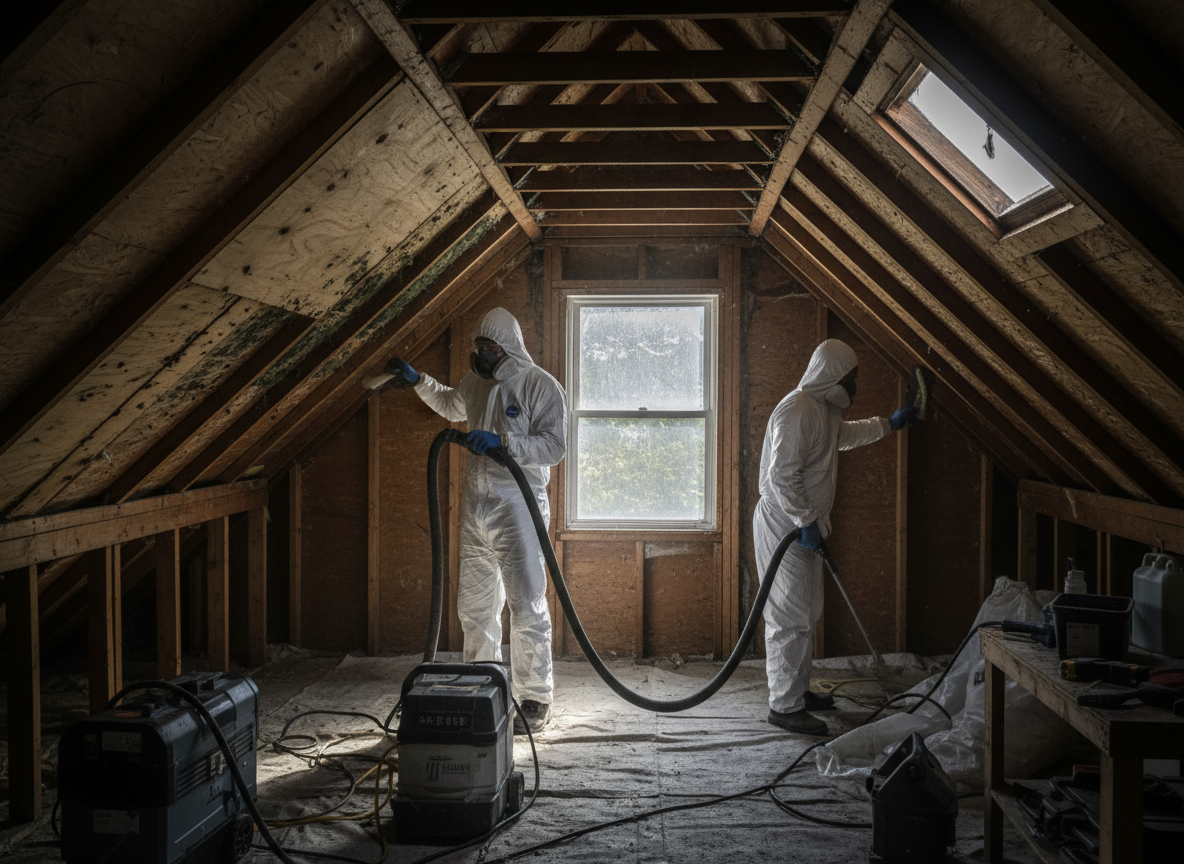
Greece sits on Monroe County’s northwest edge, where 1950s–70s ranches, split-levels, and Cape Cods along Latta Road, Dewey Avenue, and Long Pond Road still carry original attic vents that never kept up with lake-effect snow. From our shop at 1925 S Clinton Ave we drive north through Irondequoit and into 14615 neighborhoods whose low-pitch roofs trap moist air after every nor’easter. Ice dams along those eaves push meltwater into insulation; once winter temperatures drop, that moisture feeds mold on the underside of the decking. We schedule around Greece’s weekday traffic on English Road and the Saturday crush at Greece Ridge so crews can actually reach the hatch without blocking a driveway.
Attic work here is not the same as on Park Avenue or East Avenue brick doubles. Greece lots are wider but many still have side-yard setbacks too tight for a boom, so we carry materials through the garage or a second-floor window. Homes nearer Braddock Bay pick up extra humidity off the lake; houses closer to the canal see slower drainage after spring thaw. We open the job with an honest look at the existing soffit and ridge vents, then give an upfront quote you can inspect before we bag a single board. Hours are Mon–Fri 8am–6pm and Sat 9am–2pm so you are not waiting on a voicemail.
Around Greece
We regularly work near:
- 📍Braddock Bay Park
- 📍Greece Canal Park
- 📍The Mall at Greece Ridge
- 📍Greece Town Hall
- 📍Latta Road
- 📍Dewey Avenue
Attic Mold Removal in Greece — Local Notes
- •Post-war Greece housing stock—especially the 1960s splits off North Greece Road—often has 2x6 rafters and kraft-faced batts stuffed tight to the sheathing, leaving no air channel; we cut channels and add baffles before any remediation so the mold does not return the next January.
- •Lake-effect snow loads on low-slope roofs along Dewey and Latta create ice dams that force water into the attic; we treat the wet insulation and the dam cause in the same visit rather than leaving a second leak for spring.
- •Many Greece attics are reached only through a hallway hatch over a carpeted stair; we lay protection and work in sections so the rest of the house stays livable while we bag and remove contaminated material.
- •Clay soils and flat lots near the canal hold meltwater; we check for moisture coming up from the knee walls, not just from the roof, because that changes how we dry the space.