
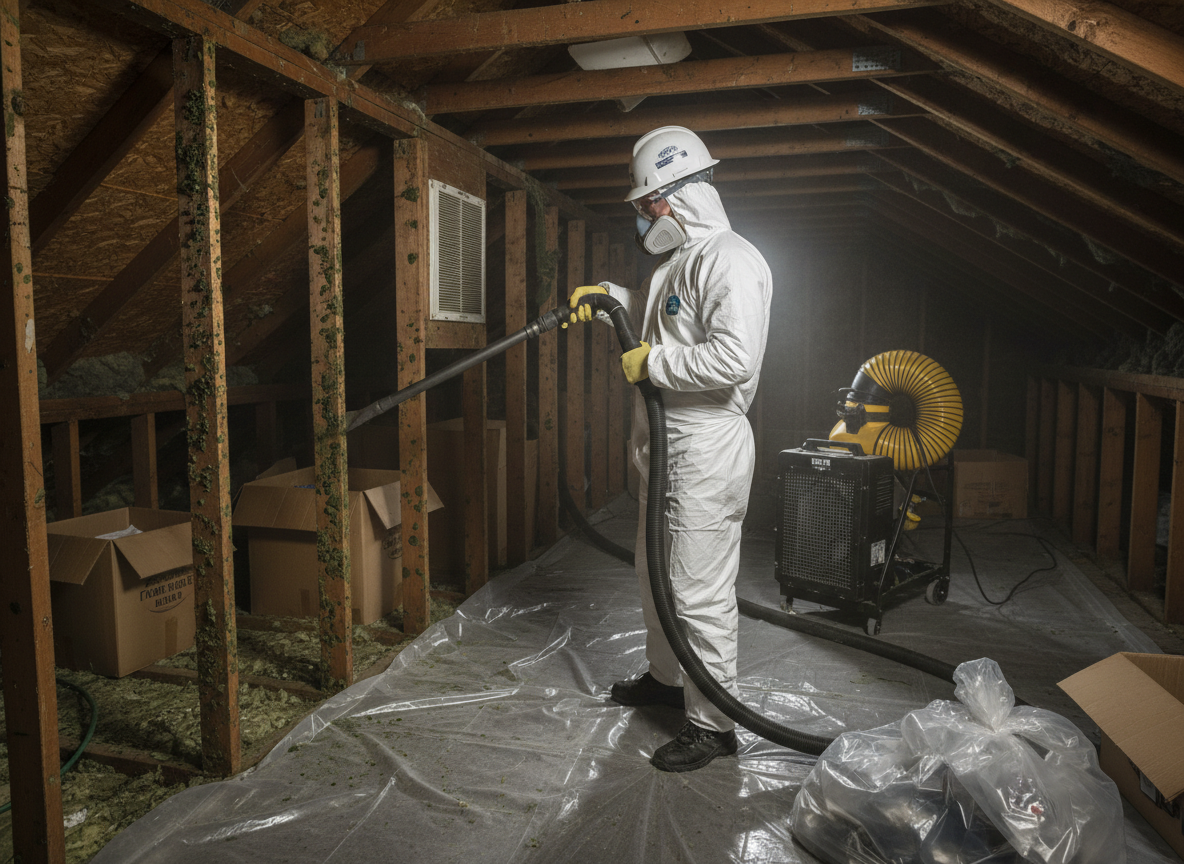
Rochester attics take a beating from a humid continental climate: long, cold, snowy winters, then spring thaw. Ice dams along East Avenue and Park Avenue roofs push meltwater under shingles into the eaves, while bathroom fans that dump into the soffit instead of outdoors load the rafters with moisture. In Monroe County’s older stock—balloon-frame Victorians near the George Eastman Museum, 1920s bungalows in Charlotte, postwar ranches toward Brighton—you often find cellulose or fiberglass packed tight against the roof deck with almost no intake at the soffits. That trapped air stays wet, and mold colonizes the sheathing, collar ties, and the back of the drywall ceiling. Remediation here is not a wipe-down; it is isolation of the attic from the living space, controlled removal of contaminated insulation, and drying that accounts for freeze-thaw, not a Florida-style fogging job.
Before any scraping starts, we treat the attic as a dirty zone. Plastic barriers at the hatch, negative air if the ceiling is open to living rooms, and HEPA filtration keep spores from drifting down into kitchens that sit under those same rafters. Rochester Public Market–area mixed-use buildings and High Falls–adjacent mill conversions add another wrinkle: shared attics and party walls, so containment has to stop at the neighbor’s joists, not just the hatch. We bag wet insulation, HEPA-vac the wood, and apply a product meant for porous lumber—not a household bleach wipe that leaves the hyphae in the grain. If the roof still leaks or the bath fan still terminates in the attic, cleanup is wasted; those sources get called out in writing so the homeowner can fix them before we close the space.
Code and common-sense notes matter on the ground. Monroe County does not require a mold license for every wipe, but once you are disturbing more than a small patch of growth, you are in renovation-disturbance territory: protect HVAC returns, keep occupants out of the work zone, and do not throw moldy cellulose in the regular trash if the bag will split on S Clinton Ave. We work Mon–Fri 8am–6pm and Sat 9am–2pm from 1925 S Clinton Ave so inspections can happen in daylight when you can actually see staining on the north slope. Edge cases we see constantly: cathedral ceilings with no attic, knee-wall storage in Pittsford colonials, and spray-foam roofs that hide wet OSB until the smell hits the second floor. Those jobs need a different sequence—cut, dry, treat—rather than a full insulation pull.
Seasonal Timing And What Homeowners Mix Up
Attic mold is often confused with dirty insulation or with roof-deck staining from old asphalt. In Rochester, the tell is usually a musty smell after a thaw, or black spotting on the north-facing sheathing once you pop the hatch. Summer is the easier dry-out window; mid-winter work means heaters and dehumidifiers fighting sub-freezing rafters, which stretches the schedule. Do not run a whole-house fan to “air it out”—that pulls spores into living space. Fix the bath fan, add soffit intake if the eaves are blocked by insulation, and keep the hatch weatherstripped so conditioned air stops feeding the attic.
Technician insight
In Rochester, the thing that catches most people out with attic mold remediation is ice-dam melt on north slopes plus bath fans that terminate in the attic instead of through the roof. Park Avenue and East Avenue houses pack insulation to the rafters and choke the soffits, so the deck never dries between snows. If you only spray the wood and leave the wet cellulose, it comes back after the next thaw.
Charlotte bungalow after a heavy snow thaw
A homeowner near the lake smelled must after meltwater ran the eaves. We found bath-fan flex dumped in the insulation and black growth on the north sheathing. We contained the hatch, pulled the wet cellulose, HEPA-vac’d and treated the wood, and flagged the fan so it could be run outdoors. The attic was left ready for clean fill once moisture readings dropped.
Attic Mold Remediation Services We Offer
✓Attic Mold Inspection and Moisture Mapping
Hatch-to-ridge look at sheathing, insulation, and bath-fan terminations in Rochester and Irondequoit homes, with moisture readings so you know what is wet versus just dirty.
✓Containment and Negative-Air Setup
Plastic isolation at the attic hatch and, when needed, negative air so spores do not drop into Park Avenue living rooms during removal.
✓Contaminated Insulation Removal
Bag-and-haul of wet cellulose or fiberglass that has been feeding mold on Monroe County roof decks, so new insulation is not laid over a dirty cavity.
✓Sheathing Cleaning and Antimicrobial Treatment
HEPA vacuum and targeted treatment of rafters and OSB after ice-dam or condensation staining, without bleaching that fails on porous wood.
✓Attic Dry-Out and Dehumidification
Equipment run until wood moisture drops, accounting for freeze-thaw winters rather than a one-day fan blast.
✓Bath Fan and Soffit Vent Corrections
Reroute fans that dump into the attic and clear blocked soffits so the same Charlotte bungalow does not re-wet after cleanup.
✓Post-Remediation Visual Check
Walk-through of the treated attic so you can see the wood and the new insulation path before we leave 1925 S Clinton Ave.
Attic Mold Remediation Cost in Rochester, NY
| Service | Typical Range | What Affects It |
|---|---|---|
| Attic hatch inspection (visual + moisture) | $150–$300 | Access difficulty, extra knee walls, or evening return trips move this. |
| Limited spotting cleanup (small area) | $400–$900 | Reach, containment, and whether insulation stays or goes. |
| Full-attic insulation pull and wood clean | $1,800–$5,500 | Square footage, cellulose vs. batts, and bag disposal. |
| Dry-out equipment (per day on site) | $75–$200 | Winter freeze vs. spring thaw; how wet the sheathing is. |
| Bath-fan reroute (attic portion) | $250–$700 | Run length to a proper outdoor termination, not into the soffit. |
Ranges are typical for Rochester, NY and confirmed with an exact written quote before any work starts.
How it works
- 1
Inspect And Isolate
We open the hatch, map staining and moisture, and set containment so work stays in the attic—not the hallway below.
- 2
Remove Wet Material
Contaminated insulation is bagged; debris is HEPA-vac’d off the wood. Sources like roof leaks or mis-routed fans are noted in writing.
- 3
Treat And Dry
Porous lumber is treated and the space is dried with equipment suited to Rochester’s cold rafters, not a quick spray-and-go.
- 4
Reset The Attic
You choose whether we leave the cavity empty for your insulator or coordinate a clean fill once moisture is stable.
Pricing
Cost tracks square footage of affected attic, how much insulation must come out, and whether we are fighting mid-winter moisture. Small spotting near a hatch is a different job than a fully packed Charlotte roof deck after ice dams. We quote after we see the space—no invented flat fees.