
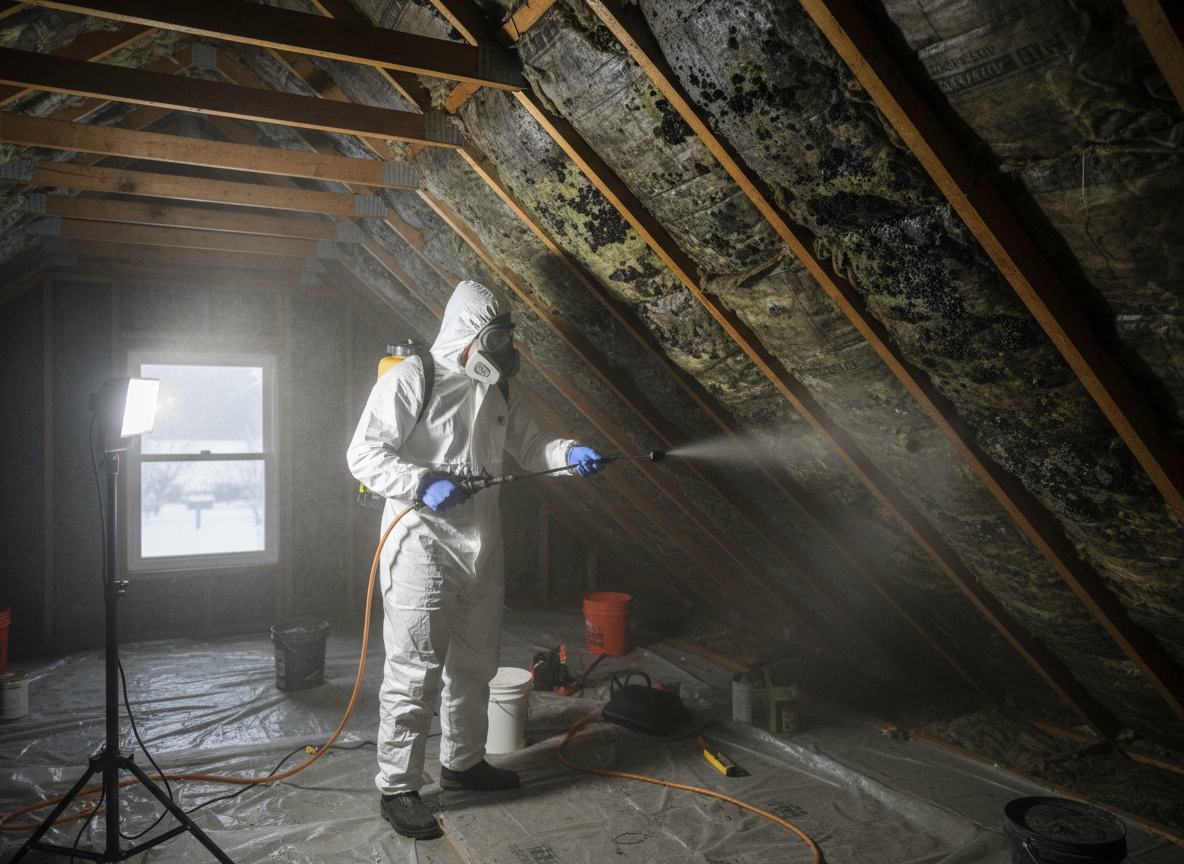
Rochester’s older housing along Park Avenue and East Avenue often carries original or mid-century cellulose and fiberglass in attics that were never designed for today’s tight envelopes. After a humid-continental winter of lake-effect snow, melt water and ice-dam leaks soak those batts; once temperatures drop, the wet insulation stays cold and stays damp instead of drying. We treat the mold in place when the material can be saved, or we pull it when it has collapsed into clumps that no longer insulate. Work starts from our shop at 1925 S Clinton Ave with weekday hours 8am–6pm and Saturday mornings 9am–2pm so you can actually reach someone after a storm.
Charlotte and lakeside blocks pick up extra humidity off the water; Brighton and Irondequoit colonials add the same problem plus low-slope roofs that trap heat at the eaves. Monroe County soil and freeze-thaw cycles also push foundation moisture upward into balloon-framed walls that dump it into the attic. That combination means we look past the visible spots and check the underside of the roof deck, the chimney chase, and the knee walls—places a surface spray never reaches. If the insulation is still fluffy and the wood is sound, we HEPA-vac, apply a targeted antimicrobial, and re-loft; if it is matted, we bag it out rather than leave a moisture sponge in place.
Code notes matter here even without a license claim: we do not encapsulate active growth under new foam, and we do not leave blocked soffit vents after we finish. Homeowners sometimes ask for bleach; it does not stay in cellulose and it can corrode fasteners on older East Avenue roofs. We use products labeled for porous insulation, keep negative air when the attic shares a stair with living space, and document moisture readings so you can see why we kept or discarded material. George Eastman Museum–era houses nearby often have unvented attics; those jobs take extra time to add baffles without tearing the historic plaster below.
Technician insight
In Rochester the thing that catches most people out with insulation mold treatment is ice-dam melt that soaks cellulose along the eaves of Park Avenue and East Avenue houses, then freeze-thaw that never lets it dry before the next storm. Homeowners often only see a stain on the ceiling and assume a spray will fix it; the wet batt is still sitting cold against the deck. We pull a handful from the edge first—if it stays in a clump, it has to come out, not get painted over.
East Avenue ice-dam soak into cellulose
A homeowner called after brown stains appeared below the eaves following a heavy snow week. We found cellulose packed against the soffits, wet six inches in, with light growth on the kraft facing. We bagged the collapsed strip, treated the deck, opened the baffles, and re-blew dry cellulose once readings dropped. The ceiling stains stopped spreading and the attic could vent through the rest of winter.
Insulation Mold Treatment Services We Offer
✓Cellulose Insulation Mold Treatment
HEPA vacuuming and antimicrobial application on blown cellulose that got wet from ice dams, common in Park Avenue and East Avenue attics.
✓Fiberglass Batt Sanitizing
Spot treatment of unfaced and kraft-faced batts when mold is limited to the paper facing and the glass itself can still perform.
✓Wet Insulation Removal
Bag-out of collapsed, moldy cellulose or fiberglass that no longer insulates after snow-melt leaks in Monroe County homes.
✓Attic Deck and Rafter Treatment
Cleaning and treating the wood under the insulation so residual spores do not re-seed new material.
✓Soffit and Baffle Correction
Clearing blocked eaves and adding baffles so treated insulation can dry instead of trapping humidity from Charlotte’s lake air.
✓Knee-Wall Insulation Treatment
Accessing finished attic rooms in Brighton and Pittsford colonials where mold hides behind plaster and old batts.
✓Post-Treatment Insulation Re-Loft
Re-blowing or re-laying clean insulation only after moisture readings confirm the cavity is dry.
Insulation Mold Treatment Cost in Rochester, NY
| Service | Typical Range | What Affects It |
|---|---|---|
| Attic moisture inspection | $175–$350 | Access, number of probe points, and whether we need to open a finished knee wall. |
| Spot treatment, salvageable batts | $400–$900 | Small wet patches near eaves or a chimney; less if we can work from existing hatches. |
| Partial cellulose bag-out and treat | $1,200–$2,800 | Depth of blown-in, how matted it is, and haul-away volume. |
| Full attic insulation removal and treat | $2,500–$6,000 | Square footage, roof pitch, and whether deck staining needs extra cleaning. |
| Baffle and soffit correction add-on | $250–$700 | Length of eaves blocked by old insulation, typical on East Avenue and Brighton roofs. |
Ranges are typical for Rochester, NY and confirmed with an exact written quote before any work starts.
How it works
- 1
Moisture Mapping And Access
We probe insulation depth, take moisture readings at the deck and eaves, and open a path that does not dump debris into living space below.
- 2
Containment And Removal Decision
If material is salvageable we treat in place; if it is matted we bag it and protect the stairwell, especially in tight East Avenue third floors.
- 3
HEPA Clean And Antimicrobial
Vacuum, treat wood and remaining insulation, and verify no standing water remains from ice-dam or plumbing leaks.
- 4
Dry-Down And Vent Check
Confirm soffits are open, add baffles if needed, and leave the attic able to dry through Rochester’s next freeze-thaw cycle.
- 5
Re-Insulation And Walk-Through
Replace only what was removed, show you the readings, and schedule around Mon–Fri 8–6 or Saturday 9–2 from the S Clinton Ave shop.
Pricing
Price follows square footage, how much insulation must come out versus stay, and access in older Rochester attics—not a phone quote. We give an on-site range after we see the wet spots.