
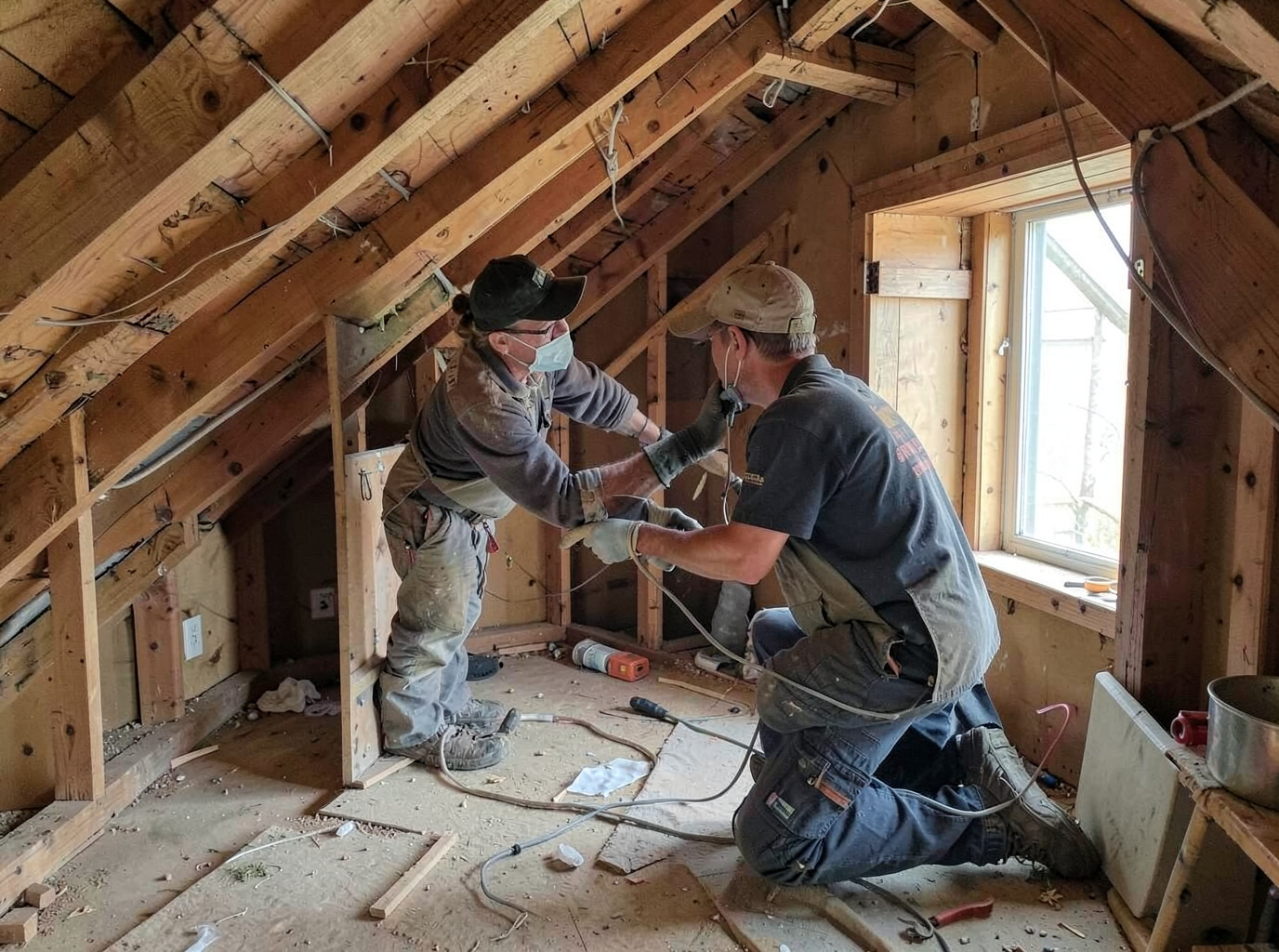
Rochester attics take a beating. Humid-continental summers load moisture into poorly vented rafter bays, then cold snowy winters lock it in as ice dams along East Avenue and Park Avenue roofs. When mold has already eaten kraft facing and stained sheathing, restoration is not a wipe-down. We open the attic from the hatch, map wet insulation versus salvageable cellulose, and decide which 2x lumber can be sanded and sealed versus sistered. Homes near Charlotte and Irondequoit often sit on older balloon-frame stock; the job changes because you cannot treat those cavities like a 1990s truss attic in Pittsford.
Monroe County code still expects combustion air and bathroom-fan termination to remain legal after we close the space. We do not bury a gas-furnace flue or pinch a ridge vent just to hide a stain. After mold is gone, we replace soaked batts with unfaced fiberglass or dense-pack that can dry if a future leak appears, then add baffles so soffits actually breathe. Ice-dam cycles around High Falls and the George Eastman Museum corridor mean we check roof-deck temperature, not just humidity numbers. If the deck stays cold, we add ventilation before we call the attic restored.
Edge cases show up in walk-up attics over converted porches and in low-slope roofs common on Brighton bungalows. Those spaces have almost no stacking height, so we work from the eaves inward, bag debris so it never hits the living floor, and use HEPA negative air when we disturb remaining fibers. We warn owners that painting over black sheathing without drying it first is a waste—stain can return the next January thaw. If wiring was run across joists in the 1920s, we flag it so an electrician can move it before we re-insulate. Restoration stops at the dry, structurally sound, vented plane—not at a pretty layer of new batts over wet wood.
From 1925 S Clinton Ave we schedule Monday–Friday 8am–6pm and Saturday 9am–2pm so we can hit freeze-thaw windows. Upfront quotes, work you can inspect from the hatch, and no invented warranties. If the roof still leaks, we will not restore the attic until that is addressed; otherwise the same ice-dam pattern will repeat on East Avenue and Park Avenue alike.
Technician insight
In Rochester the thing that catches most people out with attic restoration is ice-dam melt that soaks the outer third of the attic while the peak looks fine. Park Avenue and Charlotte roofs hold snow for weeks; owners replace only the obvious wet batts and leave stained, still-damp sheathing. Next thaw the stain returns. We always meter the eaves and insist on baffles before new insulation, because Monroe County winters will test that edge every year.
East Avenue ice-dam soak after a long freeze
A homeowner called after dark stains appeared on bedroom ceilings following a heavy snow week. We found insulation soaked along the eaves while the ridge was dry, plus blocked soffits and kraft facing that had fed mold. We bagged the wet batts, dried and sistered a few rafter tails, opened the soffits, and re-insulated only after meters were stable. Ceilings stayed clean through the next thaw.
Attic Restoration Services We Offer
✓Attic Insulation Replacement After Mold
Remove saturated batts or cellulose and install dry, vented insulation so Monroe County attics can handle snow load without trapping moisture.
✓Rafter and Sheathing Repair
Sister or replace mold-damaged 2x members and stained decking typical of older Park Avenue and Charlotte houses before closing the cavity.
✓Soffit and Ridge Ventilation Upgrade
Clear blocked soffits and add baffles so cold Rochester winters do not recreate ice dams after the mold is gone.
✓Attic Dry-Out and Moisture Mapping
Locate remaining wet pockets with meters, then dry wood to a stable reading before any new insulation goes in.
✓Knee-Wall and Hatch Restoration
Rebuild leaky knee walls and insulated hatches that dump humid air into attics on East Avenue and Brighton bungalows.
✓Debris Removal and HEPA Cleanup
Bag moldy insulation and dust so living spaces below stay clean while we restore the attic from the eaves inward.
Attic Restoration Cost in Rochester, NY
| Service | Typical Range | What Affects It |
|---|---|---|
| Attic moisture inspection and mapping | $150–$350 | Access, size, and whether we need meters in knee walls |
| Moldy insulation removal (typical bungalow attic) | $800–$2,200 | Depth, bagging, and whether cellulose vs batts |
| Limited rafter/sheathing repair | $400–$1,800 | How many members need sistering, not full re-deck |
| Ventilation baffles and soffit clear-out | $250–$900 | Blocked East Avenue eaves vs already-open ridges |
| Re-insulation after dry-out | $1,200–$4,500 | R-value target, blown vs batt, square footage |
Ranges are typical for Rochester, NY and confirmed with an exact written quote before any work starts.
How it works
- 1
Inspect And Map Moisture
We enter from the hatch, meter wood and insulation, and photograph ice-dam staining so you see what must come out versus what can stay.
- 2
Remove Damaged Material
Saturated insulation and unsound wood leave in bags; we protect floors below and keep combustion clearances legal.
- 3
Dry, Repair, And Vent
Wood is dried, sistered if needed, baffles and vents restored so snowy winters cannot trap humidity again.
- 4
Re-Insulate And Close
New insulation goes in only on dry, vented planes; you can inspect the work before we leave 1925 S Clinton Ave hours.
Pricing
Attic restoration in Rochester is scoped by square footage of wet insulation, how much wood must be sistered, and access—walk-up hatches cost less than tight knee walls. We give upfront ranges after we see the attic, not a phone number pulled from air.