
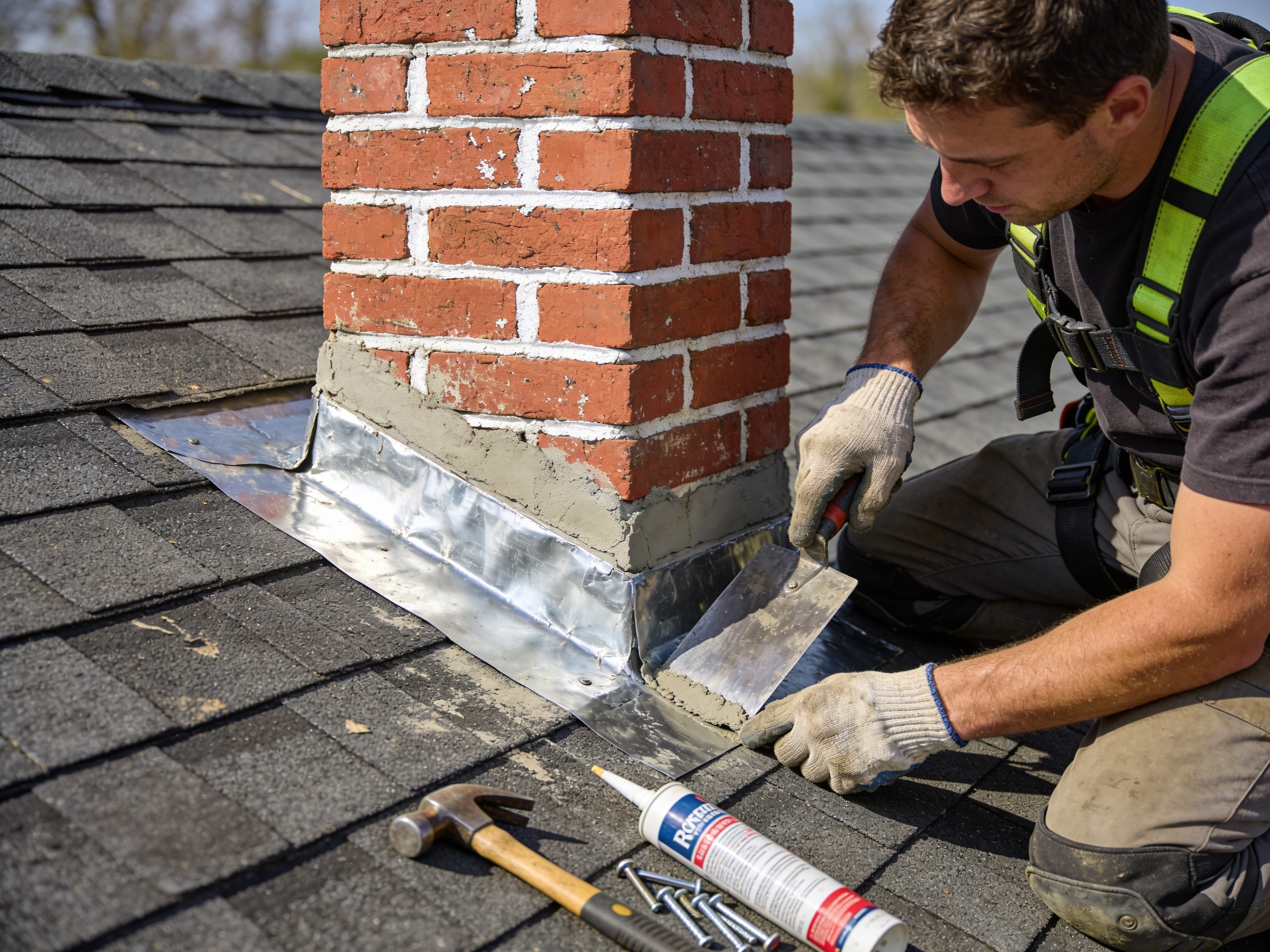
Rochester’s humid continental climate and cold snowy winters punish chimney flashing harder than many homeowners expect. Ice dams form along the upslope of brick stacks on Park Avenue and East Avenue colonials; when the dam finally releases, water sheets under failed step flashing and into the attic. Monroe County housing stock is heavy on early-20th-century masonry chimneys with original galvanized or thin copper that has long since pitted. We see the same pattern from Charlotte lakefront bungalows to Pittsford and Irondequoit colonials: the cricket (saddle) behind the chimney is undersized or missing, so snow packs against the back wall and forces water under the counterflashing. Once that water reaches the roof deck it condenses on cold sheathing and feeds attic mold—the reason many of our flashing jobs start as mold calls.
Repair is not a bead of caulk. Proper work means lifting shingles, replacing rusted step flashing with 26-gauge or heavier galvanized or copper, re-regletting the counterflashing into the mortar joints, and rebuilding a cricket that actually sheds melt toward the High Falls side of the roof rather than into the valley. On older Rochester roofs the chimney often sits at a change in roof pitch; that geometry needs a custom cricket, not a store-bought triangle. We also check the attic from the 1925 S Clinton Ave shop hours (Mon–Fri 8am–6pm, Sat 9am–2pm) so we can confirm whether the leak has already wet insulation or started staining the deck. If it has, flashing repair alone is incomplete—the wet material has to come out or the mold cycle restarts the next thaw.
A common edge case here is the chimney that was tuck-pointed years ago without re-installing the counterflashing. Mortar was packed over the old metal, trapping it. When we cut the new reglet we often find the original lead or copper still in place, now brittle. Pulling it without cracking surrounding brick takes patience, especially on George Eastman Museum-era masonry that has already seen freeze-thaw cycles. We never rely on roofing cement as a permanent seal; it hardens, shrinks, and fails the first January ice event. Code in Monroe County expects flashing to be integrated with the roof covering, not surface-applied. Homeowners who try a weekend tube of sealant usually call us after the next melt when the attic smell returns.
Technician insight
In Rochester the thing that catches most people out with chimney flashing repair is the ice dam that forms on the upslope after lake-effect snow, especially on East Avenue and Park Avenue houses with shallow rear pitches. Homeowners caulk the visible gaps, then the dam still forces water under the steps into the attic. The fix is a real cricket and regletted counterflashing, not more sealant—the same pattern we see from Charlotte to Pittsford.
East Avenue colonial after January thaw
Homeowner noticed a musty attic smell after a thaw. We found failed galvanized step flashing and a missing cricket; melt had run under the shingles onto the deck. We replaced the flashing, built a cricket, and pulled the wet insulation in that bay. The next melt stayed outside the attic.
Chimney Flashing Repair Services We Offer
✓Step Flashing Replacement
New individual shingle-integrated step pieces along the chimney sides so meltwater cannot run under the roof covering into the attic.
✓Counterflashing and Reglet Repair
Cut a fresh mortar joint, seat new counterflashing, and tool it so ice and snow cannot drive water behind the brick on Park Avenue and East Avenue stacks.
✓Chimney Cricket and Saddle Rebuild
Custom-built cricket behind the chimney that sheds snowpack toward the eaves instead of into the attic—critical on Rochester’s low-slope rear roofs.
✓Copper and Galvanized Flashing Upgrade
Swap failed thin galvanized for heavier copper or painted steel that survives Monroe County freeze-thaw without pitting through in a few seasons.
✓Ice Dam Flashing Reinforcement
Extra membrane and taller flashing at the upslope side where ice dams form after lake-effect snow, the usual leak path into Charlotte and Irondequoit attics.
✓Attic Leak Tracing After Flashing Failure
Follow the wet path from chimney to deck so we repair flashing and also address the insulation or sheathing that already grew mold.
Chimney Flashing Repair Cost in Rochester, NY
| Service | Typical Range | What Affects It |
|---|---|---|
| Step flashing replacement (typical residential chimney) | $450–$900 | Height of chimney, shingle type, and access on steep Park Avenue roofs move the range. |
| Counterflashing and reglet work | $350–$750 | Mortar condition and whether old metal is buried in prior tuck-pointing. |
| Cricket / saddle rebuild | $400–$1,200 | Width of chimney and roof pitch; custom carpentry on older Monroe County homes. |
| Copper upgrade vs galvanized | $200–$600 extra | Material cost and labor to form copper on site. |
| Combined flashing + limited attic dry-out | $800–$2,000 | Only when wet insulation is confined; larger mold jobs are scoped separately. |
Ranges are typical for Rochester, NY and confirmed with an exact written quote before any work starts.
How it works
- 1
Roof And Attic Inspection
We examine flashing, cricket, and mortar from the roof, then go into the attic to map stains and moisture so the repair matches the actual leak path.
- 2
Shingle And Old Metal Removal
Lift courses around the chimney, pull rusted step and counterflashing, and clean the mortar joints without damaging surrounding brick.
- 3
New Flashing And Cricket Install
Install new step flashing, counterflashing in a cut reglet, and a properly sized cricket that sheds toward the eaves on Rochester roof pitches.
- 4
Shingle Re-Lay And Attic Check
Relay shingles, seal only at manufacturer-specified points, then re-check the attic after the first rain or thaw to confirm the leak is closed.
Pricing
Most Rochester chimney flashing repairs fall in a mid-hundreds to low-thousands range depending on chimney size, metal choice, and whether a cricket must be rebuilt; we quote after seeing the roof and attic, not from photos. Hours Mon–Fri 8am–6pm, Sat 9am–2pm from 1925 S Clinton Ave.