
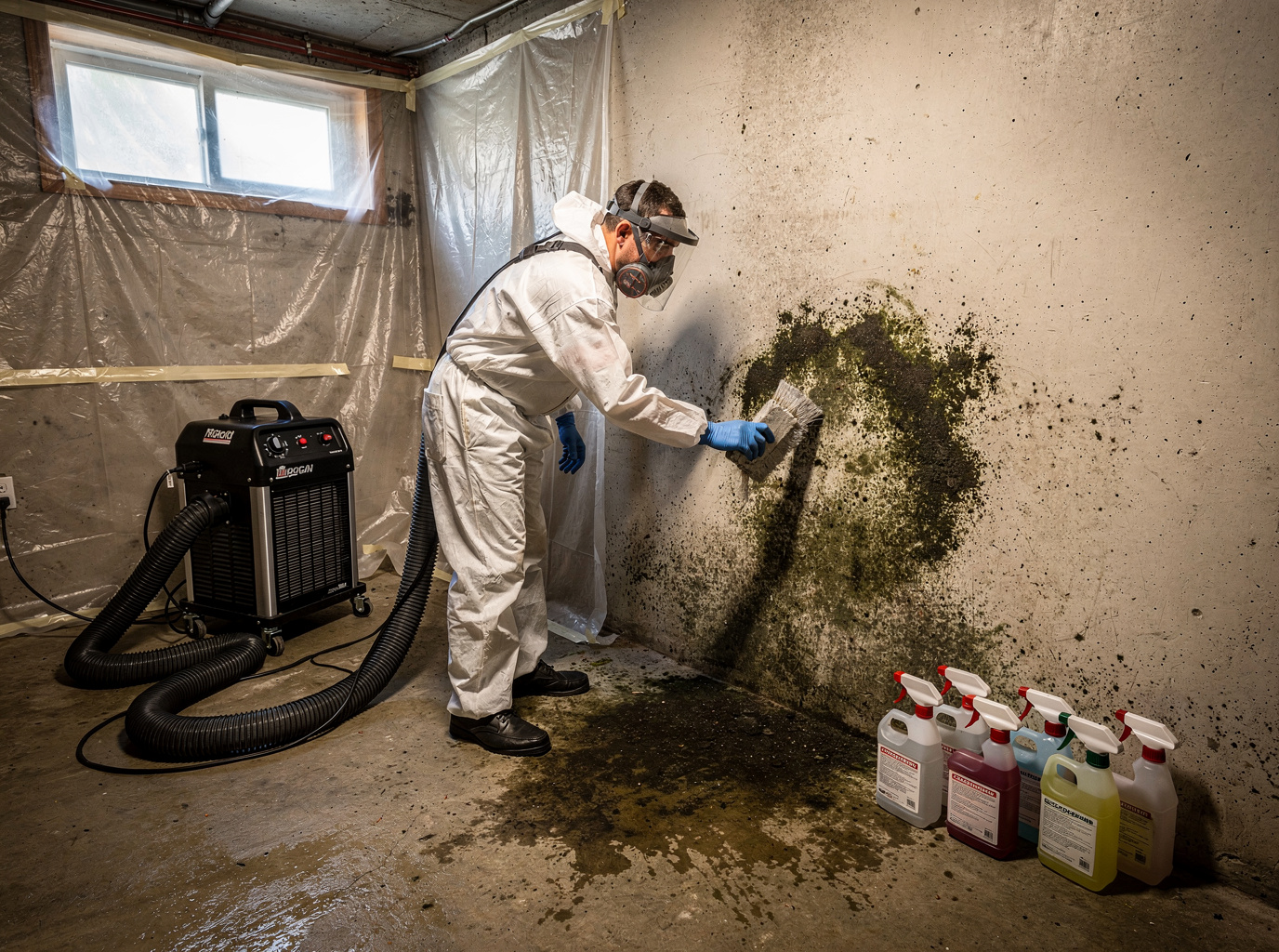
In Monroe County attics Cladosporium usually appears as olive-to-black spotting on the underside of roof sheathing after repeated ice-dam winters. Homes along Park Avenue and East Avenue were often built with limited soffit and ridge venting, so warm moist air from below rises and condenses on a cold deck. Snow sits on those roofs from December through March; melt and refreeze keep the wood damp long enough for the mold to colonize. We treat both the growth and the moisture path rather than spraying visible spots and leaving. Brighton, Irondequoit, and Pittsford stock shows the same pattern on north slopes.
Rochester’s humid continental winters mean we often work in unheated attics well below freezing, which changes product dwell times and how we bag wet insulation. Older fiberglass in Brighton and Pittsford houses traps spores; we pull it rather than coat it. After removal we trace bathroom and kitchen stacks that dump moisture into the attic—a common detail in Charlotte bungalows that sit in heavier lake-effect snow. Access from 1925 S Clinton Ave keeps us in the city; hours are Monday–Friday 8am–6pm and Saturday 9am–2pm so we can schedule around freeze-thaw windows.
Cathedral ceilings on some East Avenue Tudors hide Cladosporium on the back of the deck with no walkable attic. We use eaves or gable borescope work instead of cutting large holes. Lake-effect loading off Ontario hits Charlotte roofs harder than inland Irondequoit, so those jobs usually include ice-dam details after the mold is gone. We do not bleach wood; bleach does not kill Cladosporium in sheathing and leftover moisture restarts growth the next winter. Quotes are given after we see the attic, and you can inspect the workmanship before we leave.
When Cladosporium is active we contain the space, run HEPA air scrubbers, and keep debris from dropping into living areas below—especially important in tight Park Avenue lots near High Falls or the George Eastman Museum corridor. Insulation disposal and sheathing cleaning are sized to the actual affected square footage, not a whole-house package. If the roof deck is structurally sound we clean and treat in place; if ice dams have already cupped the plywood we flag that so you can plan roof work separately. The goal is a dry attic that does not feed the same growth next snow season.
Technician insight
In Rochester the thing that catches most people out with Cladosporium Removal is ice dams on pre-1940 Park Avenue and East Avenue roofs. Homeowners spot black staining in July and blame summer humidity, but the wood stayed wet for months under snow load with almost no soffit venting. Charlotte houses closer to the lake get dumped on harder than inland Irondequoit, so we always look at the roof from the street before we even open the hatch.
East Avenue Tudor after a long snow winter
Black spotting showed on the north roof deck once the snow finally melted. We found Cladosporium along the unvented slope where ice dams had kept the sheathing wet, plus bathroom exhaust dumping into the attic. We contained, pulled the blown-in insulation, HEPA-cleaned the deck, added baffles, and extended the exhaust. The attic stayed dry through the next winter’s snow.
Cladosporium Removal Services We Offer
✓Attic Cladosporium Inspection
Moisture mapping and visual plus borescope check of sheathing, baffles, and exhaust paths in Rochester attics so you know the extent before any removal starts.
✓Contaminated Insulation Removal
Bag-out of fiberglass or cellulose that has trapped Cladosporium spores, common in older Brighton and Pittsford attics after ice-dam winters.
✓Roof Sheathing Cleaning and Treatment
HEPA vacuum and targeted treatment of olive-black growth on the underside of the deck without bleaching wood that will stay wet.
✓Ice Dam Moisture Source Correction
Baffle, soffit, and ridge-vent work so Charlotte and East Avenue roofs stop feeding Cladosporium after the snow load melts.
✓Bathroom Exhaust Rerouting
Moving stacks that currently dump moist air into the attic, a frequent driver in Monroe County bungalows and Victorians.
✓Containment and HEPA Air Scrubbing
Negative pressure and filtration so spores do not drop into living space during attic work on tight Park Avenue lots.
✓Post-Removal Ventilation Upgrade
Adding intake and exhaust so the same condensation cycle does not restart Cladosporium the following winter.
Cladosporium Removal Cost in Rochester, NY
| Service | Typical Range | What Affects It |
|---|---|---|
| Attic inspection and moisture mapping | $150–$350 | Access difficulty, roof pitch, and whether a borescope is needed |
| Small-area sheathing treatment (under ~100 sq ft) | $400–$1,000 | Height, containment, and winter working temperatures |
| Insulation removal and bag-out | $1,000–$3,500 | Depth, square footage, and disposal from older Brighton or Pittsford attics |
| Full-slope cleaning plus ventilation tweaks | $1,200–$2,800 | Ice-dam history and existing soffit/ridge conditions |
| Exhaust reroute (bathroom or kitchen stack) | $300–$900 | Run length and whether we can stay in the attic vs. cutting drywall |
Ranges are typical for Rochester, NY and confirmed with an exact written quote before any work starts.
How it works
- 1
Inspect And Map Moisture
We access the attic, photograph staining, check temperature and humidity at the deck, and note ice-dam patterns from the street—especially on Park Avenue, East Avenue, and Charlotte roofs.
- 2
Contain And Protect Living Space
Poly and HEPA scrubbers keep debris from falling through ceilings while we work in unheated attics during Rochester’s cold months.
- 3
Remove Growth And Contaminated Materials
Insulation that holds spores is bagged out; sheathing is HEPA-cleaned and treated. We do not spray-and-leave wet wood.
- 4
Correct The Moisture Path
Baffles, vents, and exhaust routing are adjusted so winter condensation and lake-effect snow do not restart Cladosporium.
- 5
Walk-Through And Documentation
You inspect the attic with us; we leave photos and a clear list of what was done. Hours remain Mon–Fri 8am–6pm, Sat 9am–2pm.
Pricing
Most Rochester attic Cladosporium jobs land in the mid-hundreds to low thousands depending on affected sheathing area and whether insulation must come out. We quote after inspection from 1925 S Clinton Ave; no invented flat rates.