
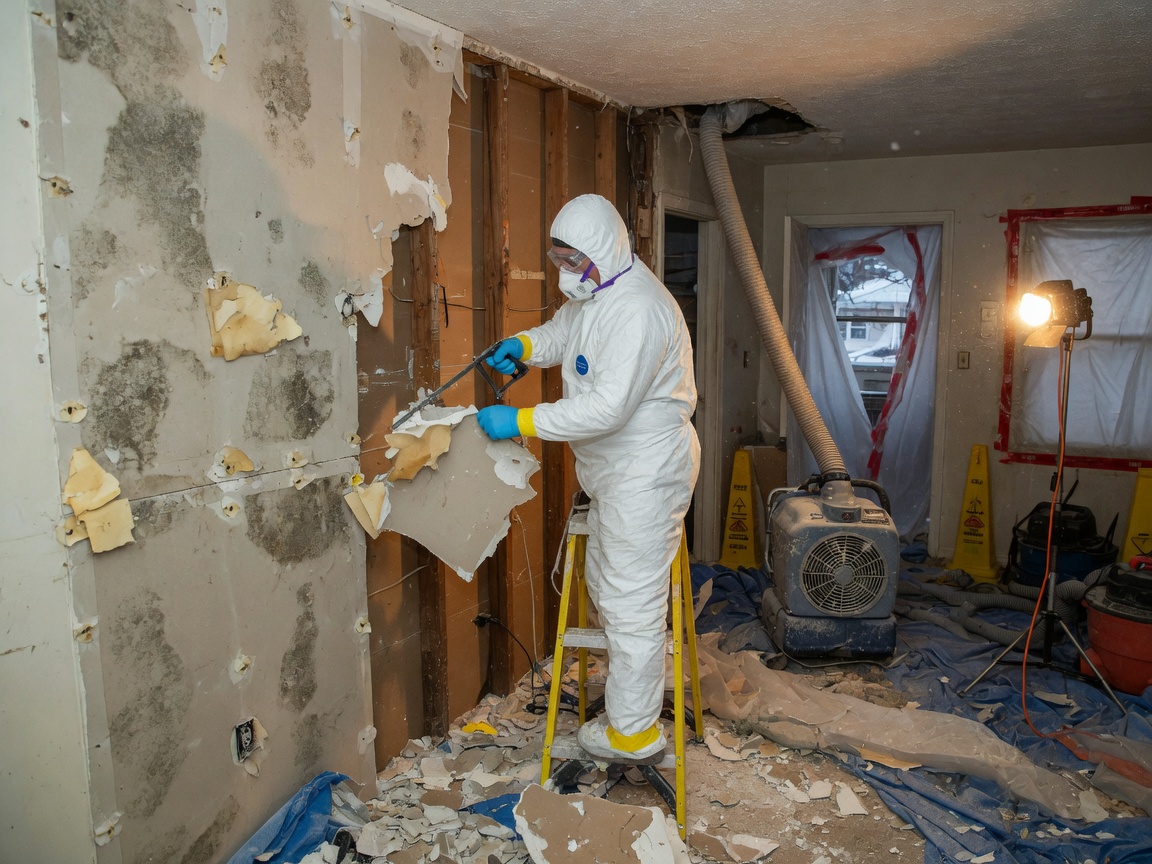
Rochester attics see repeated moisture from a humid continental climate with cold snowy winters. Ice dams form along eaves of older Park Avenue and East Avenue houses, sending meltwater under shingles and into ceiling cavities. Once that water saturates gypsum board, mold colonizes the paper facing and the cellulose in the core. We open only the affected bays, bag the material at the source, and keep spores from drifting into living space below. Homes near High Falls and the Rochester Public Market often have balloon-framed attics with limited headroom, so every cut has to be planned around existing wiring and knob-and-tube remnants.
Drywall that has stayed wet for more than a couple of freeze-thaw cycles usually cannot be salvaged. The paper delaminates, the gypsum crumbles, and any remaining fasteners rust. In Monroe County we also see mixed assemblies: plaster-and-lath ceilings in pre-war Charlotte cottages sitting next to later drywall patches. We score clean lines, support the remaining plaster, and remove only the contaminated sheets so the original lath stays intact. After the board is gone we HEPA-vacuum the joists and apply a borate treatment that remains effective through the next heating season.
Access is the real limiter. Many Brighton and Pittsford colonials have scuttle holes rather than pull-down stairs, so we stage containment from the second-floor hallway and pass bagged debris down a sealed chute. Winter work means we cannot leave the attic open overnight; we close the roof plane with temporary insulation and a vapor-retarder sheet before temperatures drop. Summer humidity still requires dehumidification so new drywall does not pick up moisture before it is taped. We work Monday through Friday 8 a.m. to 6 p.m. and Saturday 9 a.m. to 2 p.m. from our shop at 1925 S Clinton Ave.
Technician insight
In Rochester the thing that catches most people out with contaminated drywall removal is assuming the stain on the ceiling is the whole story. Ice dams on the older East Avenue and Park Avenue roofs send water twenty feet sideways along the rafters before it shows up, so we always meter the entire run, not just the obvious wet spot. Homeowners also forget that a scuttle in a Brighton colonial means every bag has to come down through living space; if we do not build the chute first, spores end up in the hallway.
Ice-dam leak over a Charlotte bungalow attic
A homeowner noticed a brown stain on the bedroom ceiling after a heavy January thaw. Moisture mapping showed the drywall was wet eight feet beyond the stain because meltwater had traveled along the balloon-framed rafters. We contained the hallway, bagged the affected sheets through a sealed chute, treated the joists, and left a temporary vapor retarder so the attic would not freeze overnight. The stain did not return the following winter.
Contaminated Drywall Removal Services We Offer
✓Attic Drywall Containment and Tear-Out
Negative-pressure containment and complete removal of mold-colonized gypsum from attic ceilings and knee walls so spores stay out of living space.
✓Ice-Dam Saturated Ceiling Board Removal
Targeted demolition of drywall ruined by repeated ice-dam leaks common on East Avenue and Park Avenue roofs.
✓Historic Plaster-To-Drywall Transition Work
Careful scoring and removal of later drywall patches while preserving original plaster-and-lath in pre-war Charlotte and East Avenue homes.
✓Moldy Drywall Haul-Away and Disposal
Bagged, labeled transport of contaminated board to an approved Monroe County facility so homeowners never handle the waste.
✓Joist and Sheathing Surface Prep After Removal
HEPA vacuuming, borate application, and moisture-meter verification of framing before any new board goes up.
✓Limited-Access Attic Drywall Extraction
Work through small scuttles typical of Brighton and Pittsford colonials using sealed chutes and staged containment.
Contaminated Drywall Removal Cost in Rochester, NY
| Service | Typical Range | What Affects It |
|---|---|---|
| Single-bay or small leak patch (under 32 sq ft) | $450–$850 | Easy scuttle access, no plaster protection needed |
| Typical knee-wall or ceiling run (32–80 sq ft) | $900–$1,800 | Ice-dam staining, mixed plaster/drywall, or limited headroom adds labor |
| Full attic plane or multiple rooms | $1,900–$3,400 | Balloon framing, knob-and-tube, or winter weather-seal extras |
| Containment and negative air (per job) | $250–$450 | Required on occupied homes near High Falls or the Public Market |
| Haul-away and disposal | $150–$300 | Volume of bagged board and Monroe County facility fees |
Ranges are typical for Rochester, NY and confirmed with an exact written quote before any work starts.
How it works
- 1
Moisture Mapping And Scope
We meter every bay, mark the wet-dry line, and photograph hidden ice-dam staining so the homeowner sees exactly which sheets must come out.
- 2
Containment And Isolation
Poly walls, zipper doors, and a negative-air machine keep the rest of the house clean while we work in the attic.
- 3
Controlled Tear-Out
Sheets are scored, bagged at the source, and lowered through a sealed chute; no loose debris is left on joists.
- 4
Framing Clean And Treat
Joists, rafters, and sheathing are vacuumed and treated, then re-checked with a moisture meter before close-up.
- 5
Temporary Weather Seal
If the job spans a cold night we install temporary insulation and a vapor retarder so the attic does not freeze or re-wet.
Pricing
Price tracks square footage of affected board, attic access, and whether plaster must be protected. Most Rochester attic jobs fall in a mid-range once containment and disposal are included; we give a written scope after the moisture map, never a round-number guess.