
2026-09-03 ·
Removing Mold From Attics in Rochester's Brick Row Houses
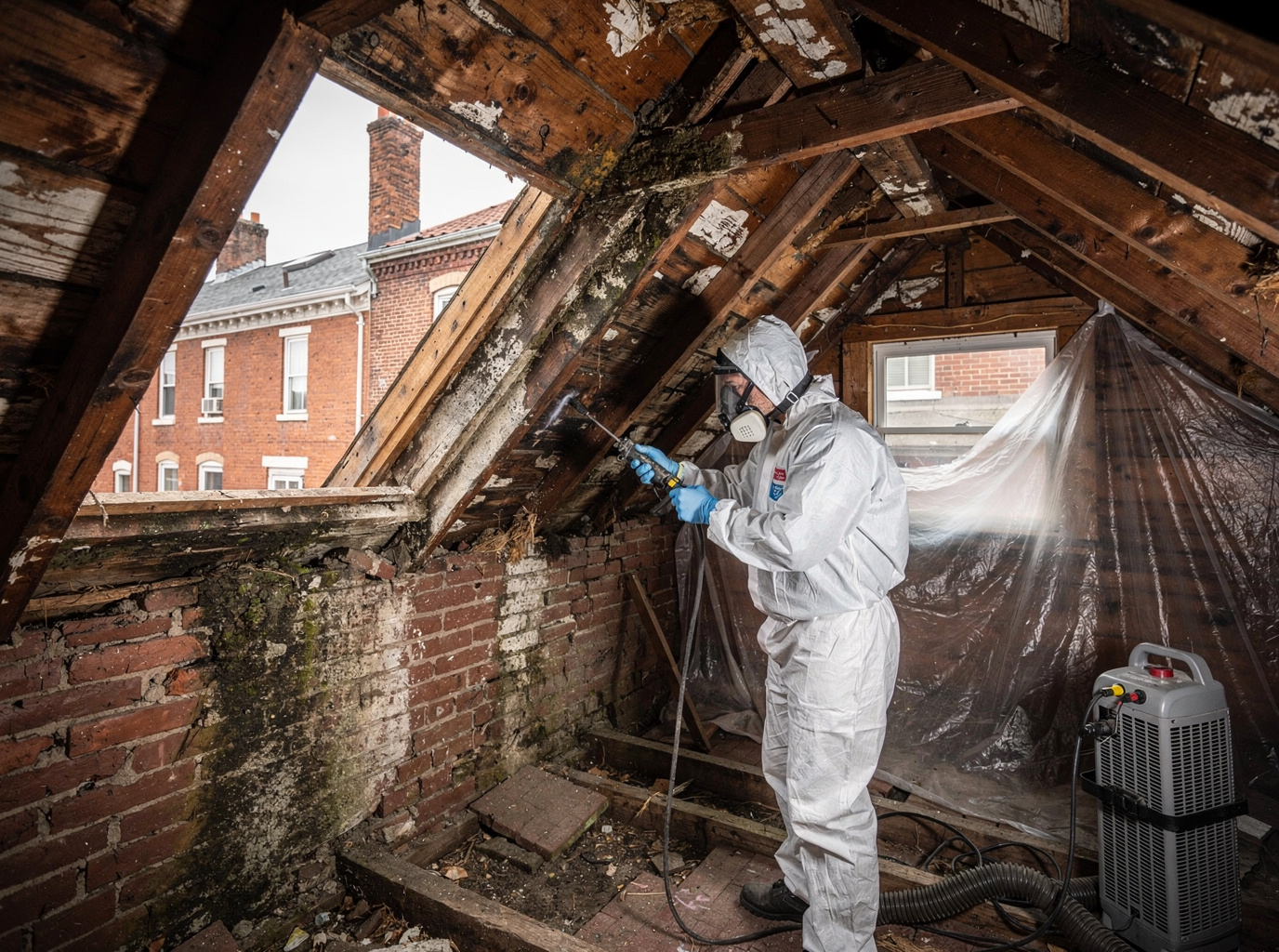
Removing mold from attics in Rochester's brick row houses means containing the space, bagging out wet or stained cellulose or fiberglass, treating rafters and sheathing, then stopping the ice-dam and stack-effect moisture that feeds growth through Monroe County's long snowy winters. The work is slower than in a suburban ranch because party walls, shared chimneys, and tight roof pitches limit access and airflow. Crews typically spend 1–3 days on a single row-house attic once the source is confirmed, not because the square footage is large but because every joint and flashing line has to be checked from the inside.
Why Brick Row Houses Trap Attic Moisture
Rochester's brick row houses—especially the blocks off Park Avenue, East Avenue near the George Eastman Museum, and older stretches toward Charlotte—were built with solid masonry walls and little or no intended attic ventilation. Warm indoor air rises through unsealed hatches and chimney chases, then hits cold roof sheathing once winter temperatures drop and snow piles on the low-slope roofs. That temperature swing produces condensation on the underside of the boards. Ice dams form at the eaves because heat leaking from the living space melts snow that refreezes at the colder overhang. Meltwater backs up under the shingles and drips into the attic. The same pattern shows up in nearby Brighton and Pittsford infill rows that share similar construction. Soil along the Genesee corridor stays damp; brick wicks some of that moisture upward, so even a dry-looking interior wall can still feed humidity into the attic. Shared party walls mean one leaky roof or unvented bath fan can affect two or three units. These are not abstract climate notes—they are the conditions that decide whether a crew can simply treat surface growth or must open the roof deck.
Typical Mold Patterns in These Attics
Growth usually starts on the north-facing rafters and the underside of the sheathing where snow lingers longest. In East Avenue rows you often see staining along the chimney flashing because the masonry stack stays cold and condenses. Park Avenue houses with later insulation dumps frequently have mold at the edges of the blown-in layer where it meets the brick. Charlotte properties closer to the lake get extra wind-driven rain that finds the same flashing gaps. The mold is rarely just on the insulation; it colonizes the wood, so wood framing treatment is part of almost every job. Hidden growth behind knee walls or in the small voids created by later ceiling drops is common; that is why a visual walk-through is not enough and hidden mold detection or air sampling is used before containment goes up. Spore types that show up repeatedly here are Cladosporium on cooler surfaces and Aspergillus or Penicillium where the insulation stayed damp. None of this requires guessing at counts—the pattern is visible once the hatch is open and a light is put on the rafters.
The Removal Sequence on a Row-House Roof
Work starts with negative-air containment so spores do not drop into the living space below. Insulation that is wet, matted, or visibly colonized is bagged and removed; cellulose is especially likely to hold moisture in these tight attics. Remaining wood is HEPA-vacuumed, then treated. If the roof deck is compromised, limited sheathing replacement happens from inside when possible so the brick façade and historic streetscape stay untouched. Moisture sources are mapped next: ice-dam paths, unsealed bath fans, and missing vapor control at the attic floor. Moisture source identification is not optional—if the leak or the stack effect is left, the mold returns after the next thaw. Ventilation upgrades are modest because many of these roofs cannot take a full ridge vent without altering the profile; soffit and hatch sealing plus a small fan or dehumidifier often do more good. Post-work verification includes a visual re-check and, when the owner wants it, follow-up sampling. The entire sequence is documented so a buyer or insurer in Monroe County can see what was done. Related reading on similar 1920s stock is in attic mold and poor insulation in 1920s Rochester homes.
Aftercare and What Recurrence Looks Like
Once the attic is dry, new insulation is installed only after the wood moisture content is confirmed low. Owners are shown how to keep the hatch sealed and how to watch the eaves after the first heavy snow. Ice-dam prevention—better insulation at the eaves, heat cables only as a last resort—matters more here than in a ranch in Irondequoit because the roof pitch is shallower and the brick holds cold. A follow-up humidity check in late winter is useful; if relative humidity in the attic climbs again, the source was missed. Recurrence usually appears first as a musty smell at the hatch or dark spotting on the north rafters, not as a sudden bloom. Addressing it early keeps the job to surface treatment instead of another full insulation pull. For cost context on older Rochester houses, see cost of attic mold removal in Rochester NY older homes. Work is scheduled Monday–Friday 8am–6pm and Saturday 9am–2pm from 1925 S Clinton Ave so winter jobs can start after the morning freeze and finish before dark. The goal is a dry, inspectable attic that stays that way through the next lake-effect season, not a one-time spray.